

This quite memorable Hermès scarf was inspired by the famous Egyptian pharaoh Tutankhamun, who ruled Egypt in the 14th century BC.

[Link to Artist’s Bio]
Designed originally in 1976 by Vladimir Rybaltchenko, Hermès reissued the “King Tut” in 1994 as part of its Sun theme for that year. At the center is the by now world famous gold death mask that was most likely made for Nefertiti and not King Tut after all. Nefertiti was King Tut’s stepmother and his father’s, King Akhenaten, chief queen.
Evidence suggests that the nineteen year old Tutankhamun may have died suddenly, which would have prompted a hurried burial possibly in a tomb intended for another.

The scarab beetle so prominently displayed in this design, is a common beetle found all around the world. It was, however, considered by the ancient Egyptians a creature of great significance and a sacred symbol in their religion and mythology; symbolizing the restoration of life and hope; it was associated with the sun god Ra. Scarab beetle amulets served for protection and good luck, and became a part of mummification.
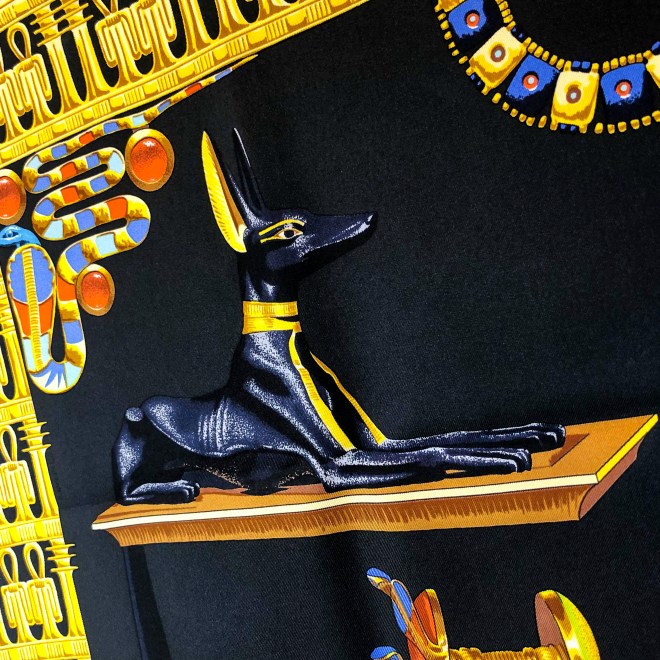
The statue of Anubis found in both upper corners of Rybal’s carre, portrays the jackal-headed god Anubis, who was believed to usher souls to the afterworld. Also associated with mummification, he was thought to protect graves.

A pair of gold cloisonne earrings are believed to have been worn by King Tut during his lifetime.
Although Tutankhamun was believed to be a very young but albeit forgettable ruler, the discovery of his intact tomb in the early 1920s by the British archaeologist, Howard Carter, propelled him to world fame.
“If Tutankhamun is the world’s best known pharaoh, it is largely because his tomb is among the best preserved, and his image and associated artifacts the most exhibited. As Jon Manchip White writes, in his foreword to the 1977 edition of Carter’s The Discovery of the Tomb of Tutankhamun, “The pharaoh who in life was one of the least esteemed of Egypt’s Pharaohs has become in death the most renowned.” “(source wikipedia)
Further immortalized by the talented hands of Vladimir (aka Rybal) Rybaltchenko, the nephew of Philippe Ledoux, the Tutankhamun Hermès carré is a true work of art that can elevate a simple outfit to that of a queen or the adorn the walls in your studio or library.


© Hermès is the exclusive property of HERMES OF PARIS, Inc., subsidiary of HERMES INTERNATIONAL
All content is the property of Carre de Paris© 2010-2025