

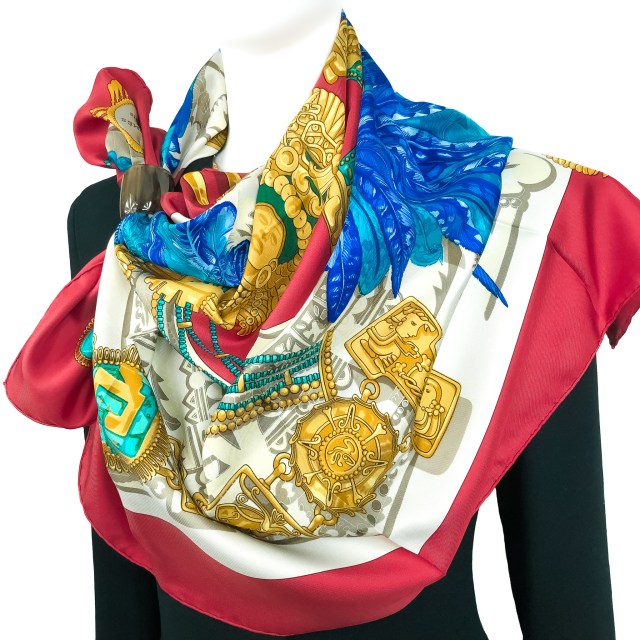
Inspired by Mexico’s Aztec culture, Madame Latham’s Mexique Hermès carré beautifully incorporates sculpture and jewelry of this ancient Mesoamerican civilization, creating a dramatic and memorable composition.

The Aztecs, who according to historians most likely originated as a nomadic tribe in northern Mexico, arrived in Mesoamerica around the beginning of the 13th century. Together with sophisticated farming and irrigation methods and a strong military tradition, their society quickly transformed first into flourishing city-states then into a powerful empire. By the early sixteenth century the Aztec empire reached its pinnacle and this highly structured society with a strict caste system was flourishing socially, intellectually and artistically.
The Aztecs’ unfailing devotion to their many gods was reflected in their magnificent temples, palaces, plazas and statues. One of these statues dedicated to Pitao Cozobi, the God of the all-important Corn crops, takes center stage in the Mexique Hermès carre.


The Aztec had a complex calendar based on a solar cycle of 365 days; this calendar played a central role in the religious rituals of Aztec society. Parts of this calendar can be seen behind the statue of Pitao Cozobi..

(Karnhack, CC BY 3.0 https://creativecommons.org/licenses/by/3.0, via Wikimedia Commons)

Jewelry was another very important aspect of this caste culture. The upper class wore many pieces that included rings, bracelets, necklaces and even anklets. A rich variety of materials ranging from shells, clay, wood, and feathers to semi precious stones like turquoise were among their favorites. Further enhancing the dramatic effects of these jewelry pieces were metals like copper, silver and gold. Unfortunately, today not many of these pieces remain, but thanks to the Mexique Hermès carre some of them have been preserved in Caty Latham’s creation.


Hermès first issued the Mexique as part of their 1985 spring/summer collection then reissued this popular design in the early 1990s, then again in 2013.

Its dramatic composition and color combinations artfully chosen by Hermès, make this design a real stand-out!
The Mexique is simply perfect for creating unique looks as it gives you the flexibility to showcase various colors based on how you tie it.
What is there not to love?


A narrated video of the Inspiration for the Mexique Hermès carre
©Hermès is the exclusive property of HERMES OF PARIS, Inc., subsidiary of HERMES INTERNATIONAL
All content is the property of Carre de Paris© 2010-2025