

Not only is Le Pont Neuf à Paris Hermès carré one of my favorites, so is that part of Paris itself.

A couple of years ago, I was fortunate to stay at a friend’s flat on the Île Saint-Louis, the small neighboring isle in the Seine, next to the bigger Île de la Cité, which gave me the opportunity to enjoy this beautiful and special part of Paris.

The view from Pont des Arts towards Île de la Cité with Notre Dame in the background and Pont Neuf connecting the isle to the rest of Paris, takes my breath away each and every time I stand on this bridge, home to thousands of “love” locks left by romantic tourists.
Pont Neuf connects the Île de la Cité to what locals call the “mainland”, in other words the rest of Paris: the Marais arrondissements to the north, the Saint Germain neighborhood to the south and the Latin Quarter to the southeast.
Monsieur Ledoux, the great illustrator of so many stunning Hermès scarves, captures life on the bridge, which I learned has played a very important role in Parisian history.

Although Notre Dame being unquestionably the most famous of all the structures on this small natural island, Monsieur Ledoux does not showcase it per se on his scarf. His is after all a tribute to the bridge itself and its place in history. Ironically the Pont Neuf, The New Bridge, is now the oldest of the Parisian bridges and one out of 37, that span across the Seine.
Construction of the Pont Neuf began in 1578, was completed in 1606 and inaugurated by Henry IV in 1607, who was the French Monarch at that time and father to Louis XIII.

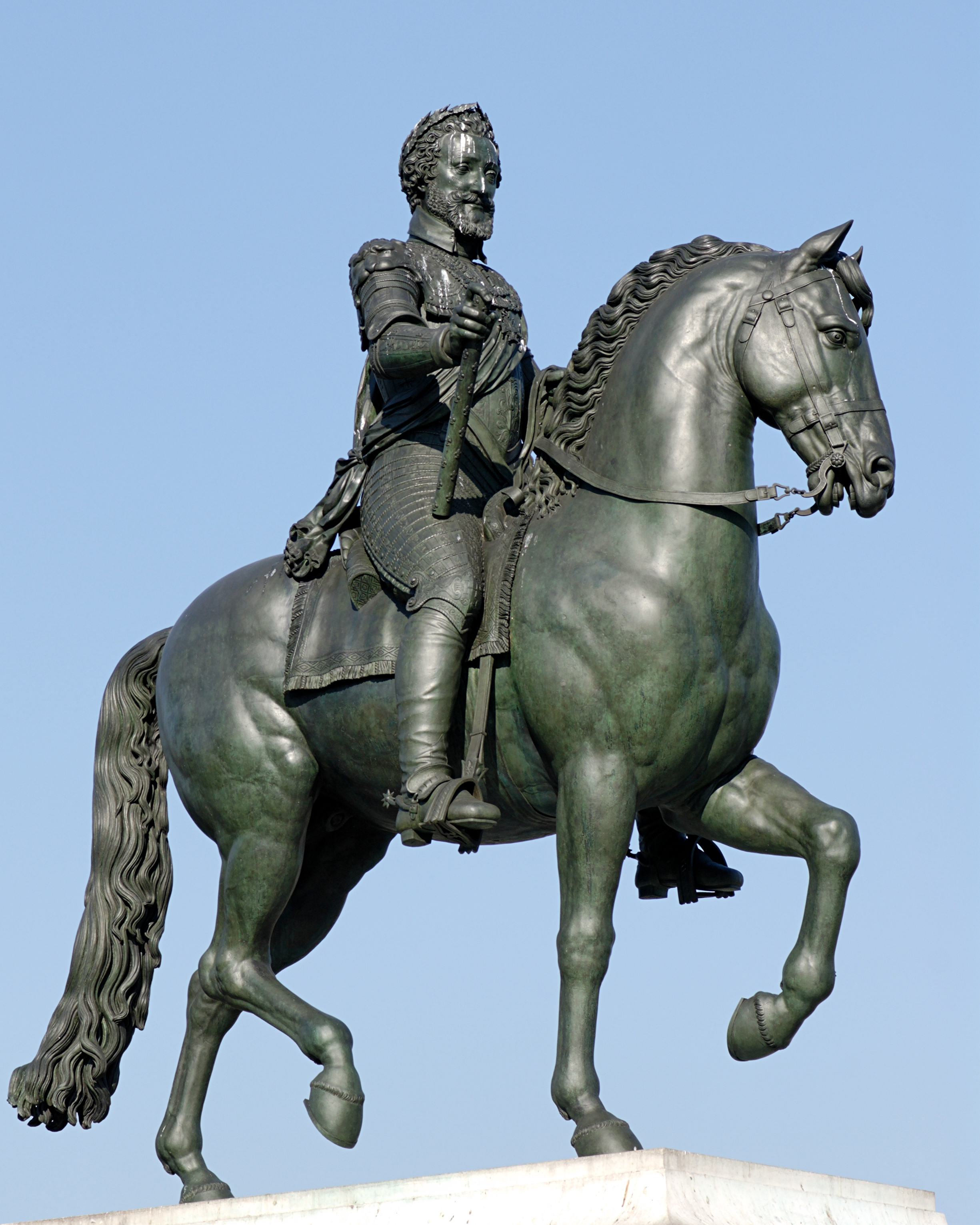
(photo courtesy Wikimedia By Jastrow – Own work, CC BY 3.0, https://commons.wikimedia.org/w/index.php?curid=3573767)
As a matter of fact the statue at the center of the scarf is that of Henry IV, which was erected in his honor after his death and still pays tribute to him in the center of the bridge today.
It was Henry IV, who insisted on omitting buildings and houses on the bridge as not to obstruct the view of the Louvre – so it is said. It was also the first bridge of its kind, that was pedestrian friendly, boasting sidewalks and bastions for pedestrians to evade large carriages, which were starting to crowd the streets of Paris.

I am not sure that being pedestrian friendly was necessarily the main goal, but possibly a positive byproduct, as commerce and the flow of goods across the Seine were the primary objectives.


Pont Neuf was to connect Paris with the goal to promote commerce and trade and Henry as a new ruler wanting to make a statement, was going to accomplish New Bridge, the Pont Neuf.
This bridge was to be a strong bridge built of stone and not wood like its contemporaries. One capable of withstanding a lot of traffic and a lot of commerce. It was also to be wider than its contemporaries. Simply put, it was to be a grand bridge, a testament to the new king, his forward thinking and quite modern approach to urban planning.
After its completion, the Pont Neuf quickly became an instant celebrity and was loved by both the poor and rich alike. The Pont Neuf was pretty much what the Eiffel Tower is for Paris today, a huge tourist attraction.
I noticed four different dates, one in each corner of the scarf. Not being a history buff, they did not immediately jump out at me other than perhaps the 1775 and 1792 dates, the other two, I am afraid to admit, did not even cause the slightest of stirs 🙂
So what significance do these dates have, if any? (and here I once again, welcome any input)

Lets start with 1640 – by this date the Pont Neuf has reached celebrity status. It is popular with Parisians of all economic standings; merchants of all kind gather and do business on the bridge with the statue of Henry IV in the background.

1775 – Besides the beginning of War with the American Colonies, and the Flour War paving the way for the French Revolution, I cannot find much else???
By the way … the Pont Neuf is still very popular with all the Parisians!

1792 marks the French Revolution and fall of the French Monarchy. Indeed an important date.

1860 marks the year that Napoleon creates eight new arrondissements and expands Paris to its current limits. And yes, Paris has grown, the bridge has had a facelift and Paris still loves it’s Pont Neuf.
Philippe Ledoux possesses a remarkable talent for breathing life into the Parisian past, not only in this scarf but in numerous others, such as Promenade de Longchamps and Promenade de Paris, which I will explore in more detail soon. [Link to this post].
The Hermès Le Pont Neuf à Paris scarf is a treasure trove of vibrant details. It depicts a bustling scene of Parisians engaged in their daily lives: bartering, chatting, and navigating the lively crowds. Even amidst historical change, the majestic Pont Neuf and the surrounding city have been in constant flux, evolving and adapting without skipping a beat.
To delve deeper into the history of the Pont Neuf and its profound impact on Paris, I recommend the insightful article The Birth of the Pont Neuf: How a simple bridge made Paris the world’s first modern tourist destination by Joan DeJean, Trustee Professor at the University of Pennsylvania and acclaimed author of ten books.


© Hermès is the exclusive property of HERMES OF PARIS, Inc., subsidiary of HERMES INTERNATIONAL
All content is the property of Carre de Paris© 2010-2025
Pingback: Promenades de Paris Hermès Carré – Inspiration – The World of Hermes© Scarves
Pingback: HERMES Promenades de Paris 1962 Collector Carre – The World of Hermes© Scarves
Pingback: Les Ponts de Paris HERMES Scarf – Carre de Paris
Pingback: Pont Neuf Paris and the HERMES Scarf it Inspired | Carre de Paris
Pingback: How to store your HERMES scarves | Carré de Paris