


Revised 8/27/2024
I have been asked numerous times about the history, inspiration and meaning behind the Napoléon Hermès Carré.
This is what I know and please feel free to correct me, as I am by no means neither a historian nor an expert on Napoléon.
This is what I do know …

The Hermès Napoléon scarf, designed by Philippe Ledoux in 1963, is a masterpiece of textile art that pays homage to one of history’s most iconic figures.
The intricate bee jacquard weave, featuring a rich tapestry of colors and symbols, invites the viewer to delve into the world of Napoleonic France.
The “bee” motif, a symbol of imperial power and resurrection, echoes Napoleon’s ambitious dreams of a new dynasty. The Legion of Honor chain, framing the central vignette, signifies the highest honor bestowed by the French Empire.


In Ledoux’s by now iconic design, we find five vignettes, that I believe depict Napoleon’s most significant moments in his life and are based on paintings by several French artists such as Jacques-Loius David and Pierre Gautherot.

At the center and possibly the most significant vignette, framed by the Legion of Honor Chain, is Napoleon’s arrival at Notre Dame for his coronation that took place there December 2nd, 1804 making him the Emperor of the French.
The other four medallions in the corners of the scarf, are all framed by laurel wreaths. The upper right corner of the scarf depicts Napoleon on one of his Arabian horses and was likely inspired by the painting, Napoléon Bonaparte, First Consul, Reviewing his Troop after the battle of Marengo by Jean-Antoine Gros.


In the vignette by the artist’s signature bottom right, we have Napoleon spying through a looking glass during the Battle at Wagram.


To the left of the modern day Hermès copyright in the bottom left corner of the carré, the wounded Emperor of France is aided by fellow soldiers.


(Public domain, via Wikimedia Commons)

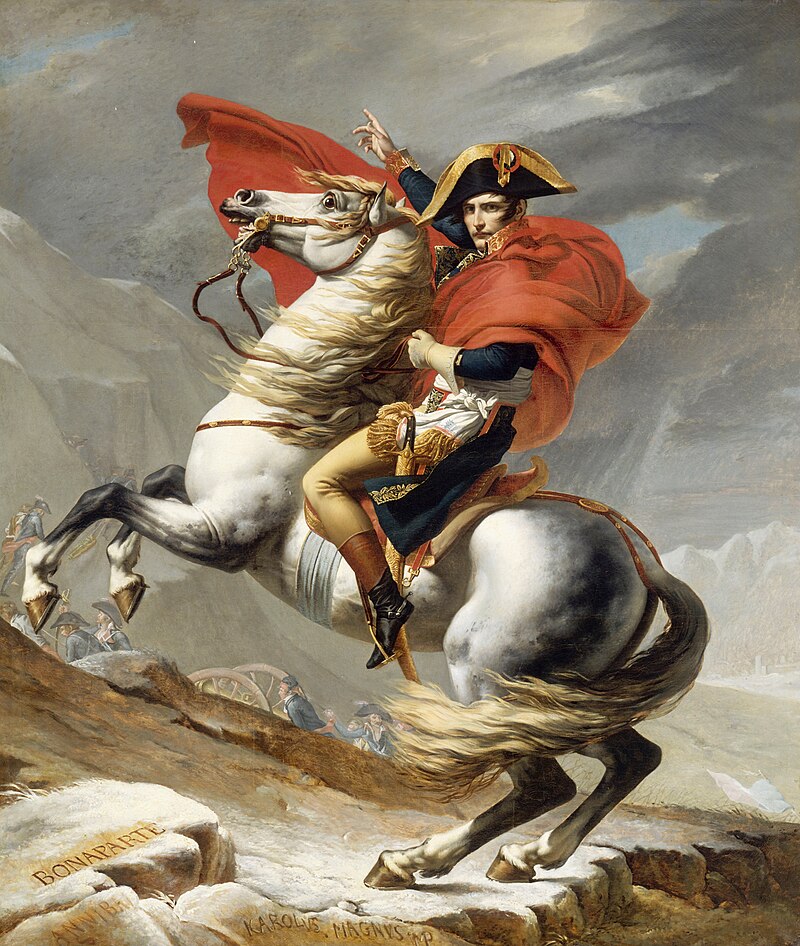
Lastly in the upper left corner we have a triumphant Napoleon Crossing the Alps no doubt borrowed from the painting of the same name by Jacques-Louis David (1748-1825)

(Wikipedia)

Ledoux also incorporated items symbolic of Napoleon himself and the Napoleonic Age.

Napoleon’s famous hat is at the bottom center, his sabers and the Eagle, which represented along with the “bee” (weave of the jacquard and background for the scarf) military victory, immortality and resurrection respectively.

I believe the uniforms are Napoleon’s uniforms with the one on the right being an “every day” uniform, whereas the one on the left, much more detailed and intricate in nature, might be the uniform Napoleon was buried in.

It is my belief, that Ledoux chose the numbers 2 and 5 because they represent the two most significant dates during the Napoleonic Age, Napoléon’s coronation on December 2nd, 1804 and his death on May 5, 1821.
Beyond its historical significance, the scarf’s luxurious silk and vibrant color palette create a tactile and visual experience that endures.
The Napoléon Hermès carré is a testament to the enduring fascination with Napoleon and a timeless piece of fashion.
This truly stunning scarf with its incredible details, richness and texture, is a true work of art and like its subject, an iconic part of history!

©Hermès is the exclusive property of HERMES OF PARIS, Inc., subsidiary of HERMES INTERNATIONAL
All content is the property of Carre de Paris© 2010-2025